

Boot Lace Size Guide | Smoke Eater Gear Duty Fit
Find your Duty Fit before you order.
A boot lace size guide should do more than count eyelets. Real boots vary by height, shaft shape, speed hooks, tongue thickness, lacing method, and how the wearer actually ties them.
Buying the wrong lace length is one of the most common frustrations boot owners face. Too short and you cannot properly lace your boots. Too long and you’re left with excess lace hanging loose or wrapped around the boot.
Smoke Eater Gear developed the Duty Fit system to help firefighters, first responders, tradesmen, and boot enthusiasts find the right boot lace length for work boots, duty boots, station boots, logger boots, tactical boots, heritage boots, and everyday footwear without the guesswork.
Use this guide to find a practical starting point before ordering replacement boot laces.
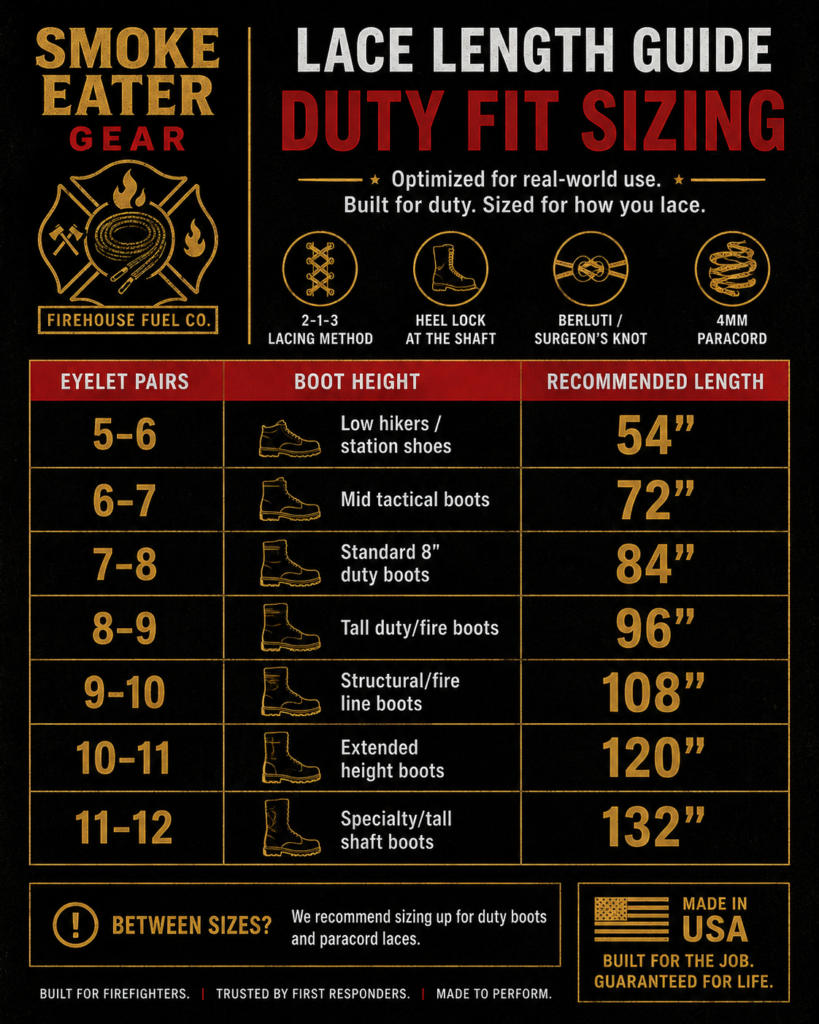
| Eyelet Pairs | Typical Footwear | Recommended Length |
| 5-6 | Station Shoes / Low Hikers | 54″ |
| 6-7 | Mid Tactical Boots | 72″ |
| 7-8 | Standard 8″ Duty Boots | 84″ |
| 8-9 | Tall Duty / Fire Boots | 96″ |
| 9-10 | Structural / Wildland Boots | 108″ |
| 10-11 | Extended Height Boots | 120″ |
| 11-12 | Specialty Boots | 132″ |
Custom lengths are also available for specialized applications. This boot lace size guide is intended to give customers a practical starting point before choosing replacement boot laces.
Built Around Real Boots
Not All Boots Are Worn The Same Way
Two boots may have the same number of eyelets and still require different lace lengths. The way a boot is used often matters more than the eyelet count alone.
Work boots are commonly worn with longer lace lengths that allow for secure adjustment, heel-lock lacing, and all-day comfort. Heritage boots are often worn with shorter lace lengths that create a cleaner appearance with minimal excess lace.
The Duty Fit System helps determine which sizing approach best matches how your boots are actually worn.
Duty Fit Work Sizing vs. Duty Fit Heritage Sizing
Duty Fit Work Sizing
Designed for firefighters, EMS, law enforcement, construction workers, linemen, loggers, tradesmen, and anyone who relies on their boots for demanding work.
- Secure fit
- Heel-lock compatible
- Maximum adjustment
- Long shifts and demanding environments
- Function-first approach
Common Examples
- Nicks BuilderPro
- White’s Smokejumper
- JK Superduty
- Thorogood Logger
- Danner Quarry
Duty Fit Heritage Sizing
Designed for heritage, lifestyle, and everyday wear boots where appearance and proportion are just as important as function.
- Clean appearance
- Minimal excess lace
- Smaller knot profile
- Traditional styling
- Appearance-focused fit
Common Examples
- Grant Stone Diesel
- Grant Stone Brass Boot
- Red Wing Iron Ranger
- White’s Semi-Dress
- Nicks Falcon
- Nicks Americana
Duty Fit Heritage Sizing
Most heritage boots are worn differently than work boots. Owners often prefer shorter lace lengths that create a cleaner appearance while still providing secure adjustment.
| Eyelets | Heritage Recommendation |
| 5 – 6 | 45″ – 54″ |
| 6 – 7 | 54″ – 63″ |
| 7 – 8 | 63″ – 72″ |
| 8 – 9 | 72″ – 84″ |
| 9 – 10 | 84″ – 96″ |
Which Duty Fit System Should I Use?
Choose Duty Fit Work Sizing if your boots are primarily used for work, firefighting, law enforcement, logging, construction, utilities, or other demanding environments.
Choose Duty Fit Heritage Sizing if your boots are primarily worn for casual, heritage, lifestyle, or everyday use where a clean appearance is preferred.
Some brands produce both work-oriented and heritage-oriented models. In those cases, the specific model and intended use are often more important than the brand itself.
If you’re unsure which category best describes your boots, contact us before ordering and we’ll help you determine the right fit.
Use this boot lace size guide with your boot brand, eyelet count, speed hooks, and preferred lacing method to choose the best starting length.
Explore Duty Fit Guides
Find lace length recommendations for popular boot manufacturers based on real-world experience, common configurations, and Duty Fit guidance.

Work & Heritage Models

Work & Heritage Models

Work & Heritage Models

Work-Oriented Models
Work-Oriented Models

Work-Oriented Models

Work-Oriented Models

Work & Heritage Models

Work & Heritage Models

Heritage-Oriented Models

Heritage-Oriented Models
Heritage-Oriented Models
More Guides Coming
We’re continually expanding the Duty Fit Resource Library.
Frequently Asked Questions
How do I know if my laces are too short?
If you struggle to tie your boots comfortably using your preferred lacing method, your laces are likely too short. A lace may technically reach the top of the boot but still leave insufficient length for a secure knot, heel-lock, or other advanced lacing techniques.
How do I know if my laces are too long?
Excess lace hanging below the knot, wrapping around the boot, or creating a snag hazard may indicate a longer length than necessary. Some users intentionally prefer additional length, while others prefer a cleaner, more streamlined fit.
Do speed hooks require longer laces?
Yes. Speed hooks generally consume more lace than traditional eyelets. Two boots with the same height may require different lace lengths depending on their eyelet and hook configuration.
Does my lacing method affect the length I need?
Absolutely. Heel-lock lacing, ladder lacing, the 2-1-3 method, and other specialty techniques can require additional lace compared to traditional crisscross lacing.
Why doesn’t the manufacturer’s recommendation always work?
Manufacturers typically provide generalized sizing guidance. Differences in boot size, eyelet spacing, speed hooks, lacing methods, and personal preference can all affect the ideal lace length.
Popular Boot Models
The recommendations below are intended as starting points based on common configurations and lacing methods. Individual preferences and boot specifications may affect the ideal lace length.
Nicks BuilderPro
Typical Recommendation: 96″ to 108″
The BuilderPro is one of the most frequently discussed boots in workwear and heritage boot communities. Users who prefer heel-lock lacing or additional lace tail length often prefer 108″.
Nicks Tactical
Typical Recommendation: 84″ to 96″
Lace length requirements vary depending on boot height and preferred lacing method.
JK Superduty
Typical Recommendation: 96″ to 108″
Many users prefer longer lengths when utilizing advanced lacing techniques or taller boot configurations.
White’s Smokejumper
Typical Recommendation: 96″ to 108″
Boot height, eyelet spacing, and personal preference can significantly influence the ideal length.
Danner Acadia
Typical Recommendation: 84″
Most users find 84″ provides sufficient length for standard lacing methods.
Haix Fire Eagle
Typical Recommendation: 72″ to 84″
The ideal length depends on the specific model and lacing configuration.
Thorogood 8-Inch Moc Toe
Typical Recommendation: 84″
A popular choice among tradesmen, firefighters, and industrial workers.
Red Wing Iron Ranger
Typical Recommendation: 72″
Most users find 72″ provides a clean fit with adequate knot length.
Red Wing Classic Moc
Typical Recommendation: 72″
Length preferences vary depending on boot size and lacing style.
Need Help Finding the Right Fit?
Not every boot fits neatly into a chart. If you’re unsure which length is right for your boots, contact us before ordering.
Tell us your boot brand, model, height, and number of eyelets or hooks. We’ll help you find the right fit.
Why Generic Lace Charts Often Fail
Most boot lace size charts focus exclusively on boot height or eyelet count. That can work for basic shoes, but it often falls short for work boots, duty boots, firefighter boots, logger boots, and heritage boots. Unfortunately, those factors only tell part of the story.
Smoke Eater Gear’s Duty Fit approach considers how boots are actually worn. Speed hooks, taller shafts, thicker tongues, larger eyelets, and advanced lacing methods can all increase the lace length needed for a secure fit.
Eyelet spacing, speed hooks, boot size, lacing methods, and personal preference all influence the amount of lace required. Two boots with the same number of eyelets can require dramatically different lace lengths.
The Duty Fit system was developed to account for the factors that generic charts often ignore, helping customers get closer to the right fit the first time. Choosing the right replacement boot laces starts with the boot itself, not a one-size-fits-all chart.